

How to export a document
1
Open the document you want to export.
2
Click the Share button in the top-right corner.
3
Select Export As.
4
Choose a format.
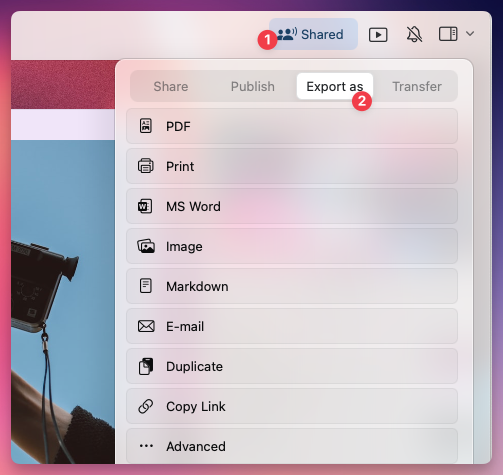
Available export formats
- macOS
- iOS
- Windows
- Web
- PDF (.pdf) – A formatted, print-ready file.
- Microsoft Word (.docx) – A Word file you can keep editing.
- Image (.png/.jpeg) – The document as an image file.
- Markdown (.md) – Plain text that keeps structure and basic formatting.
- TextBundle (.textbundle) – Markdown together with its images and attachments.
- Email – Sends the document by email.
PDF export options
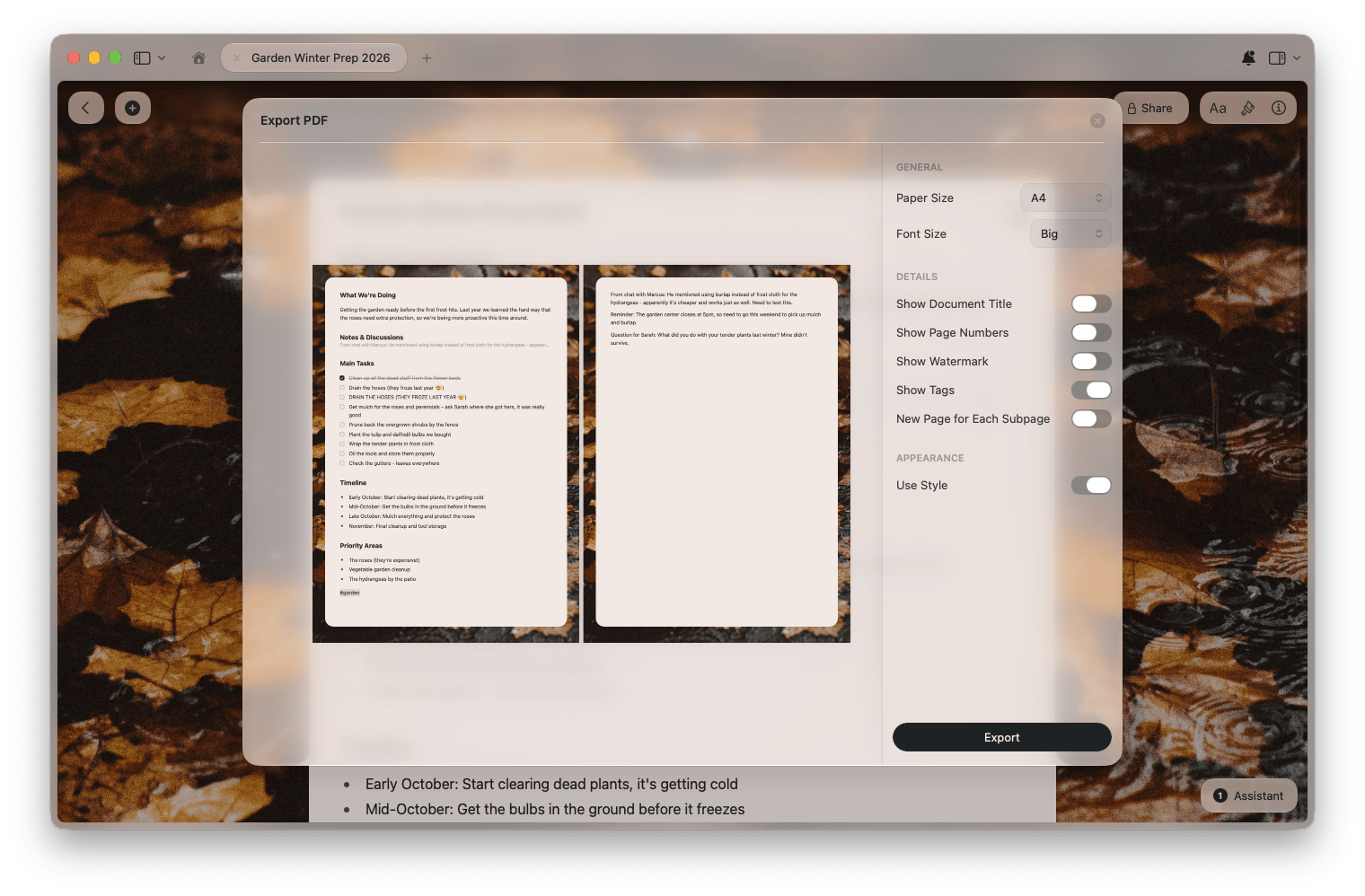
PDF export opens a sheet with options for paper size, font size, and what to include. The options and their defaults differ by platform.- macOS / iOS
- Web / Windows
Craft remembers the settings from your last export.New Page for Each Subpage starts every subpage on a new page of the PDF. The toggle only appears when the document has subpages.
The sidebar Table of Contents is a navigation view. It is not included in PDF exports, and there is no Table of Contents block to insert into a document. See Table of Contents.
To export or copy tables made in Craft to Excel:
- Export the document or page from Craft to Word.
- Copy the table in Word and paste it into Excel.
Export collections as Markdown
On Mac, iPhone, and iPad, Markdown exports can include the properties of collection items as frontmatter, and you can export every item in a collection as a separate Markdown file.Include properties as frontmatter
When you export a single collection item, or a document that contains a collection, as Markdown, the export options include a Properties as Frontmatter toggle. It is on by default. With the toggle on, each item’s properties are added as YAML frontmatter:- For a single item, the frontmatter is at the top of the file.
- For a document that contains a collection, the frontmatter appears under each item’s title.
Export a whole collection
1
Open the collection menu with the settings button (sliders icon) at the top of the collection.
2
Select Export, then Export Items as Markdown.
3
Choose where to save the files. On iPhone and iPad, the share sheet opens.
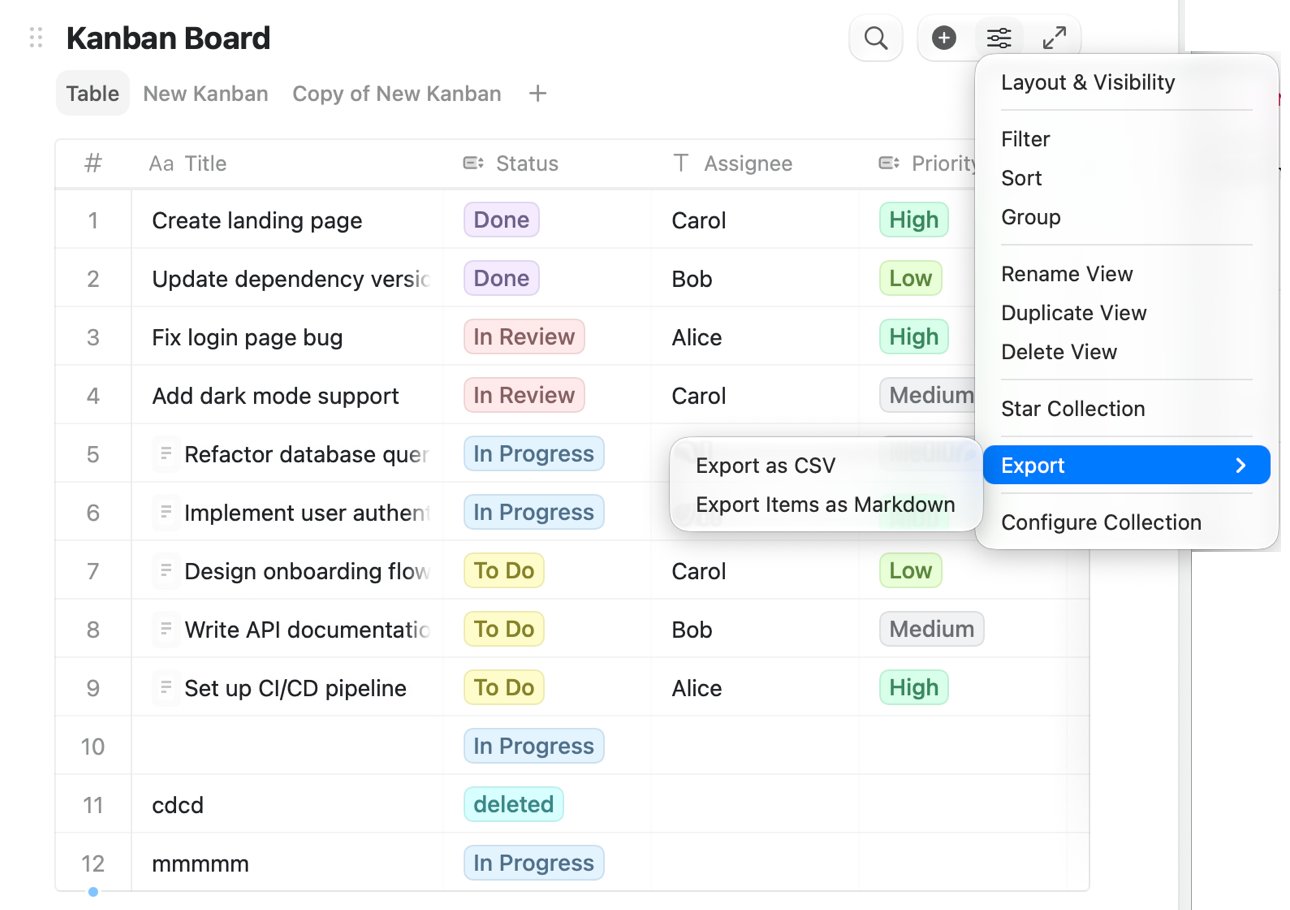
- One Markdown file per item, named after the item’s title, with the item’s properties as frontmatter.
- index.md, a table of the whole collection with a Title column and one column per property.
- An .assets folder for each item that contains images, videos, files, or drawings.
On Web and Windows, Markdown export of collection items and the Properties as Frontmatter option are not available. To export a collection, use Download as CSV in the collection menu.
Exporting multiple documents at once
Bulk export is available on Mac and iPad in these formats:- Markdown (.md)
- TextBundle (.textbundle)
- PDF (.pdf)
1
Navigate to a folder that contains the documents you want to export.
2
Select multiple documents by tapping and holding (iPad) or using Shift + Click (Mac).
3
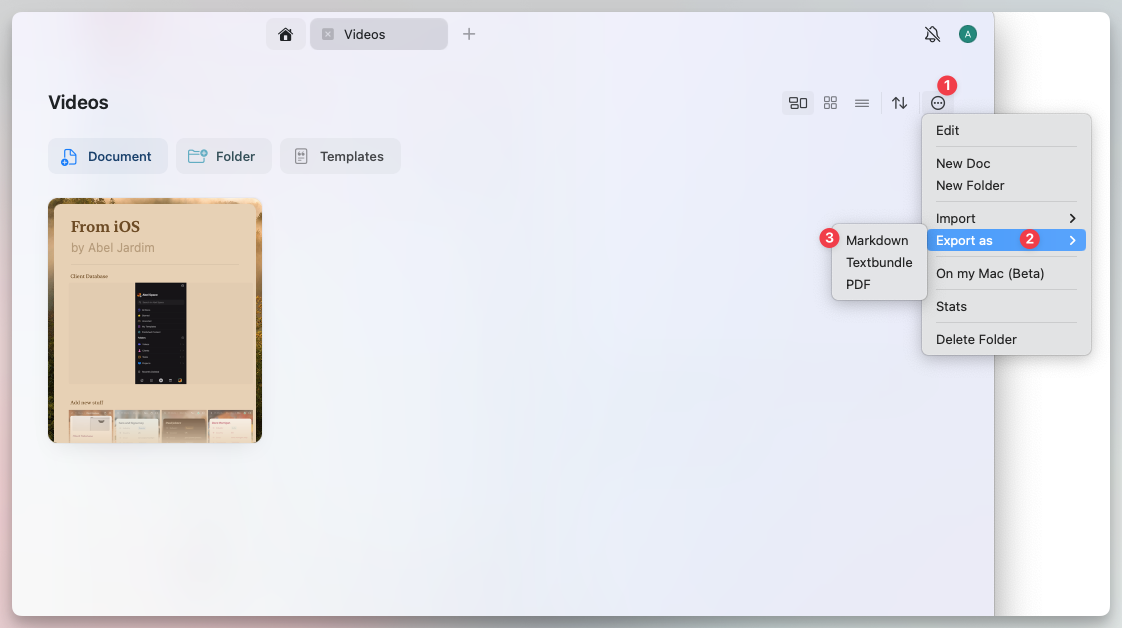
Tap the three-dot menu (⋯) in the top-right corner.
4
Select Export As, then choose a format.
Export daily notes
On Mac, iPhone, and iPad you can export your daily notes as Markdown files. Export all of them at once, or pick a date range. You can start the export from two places:- From All Docs
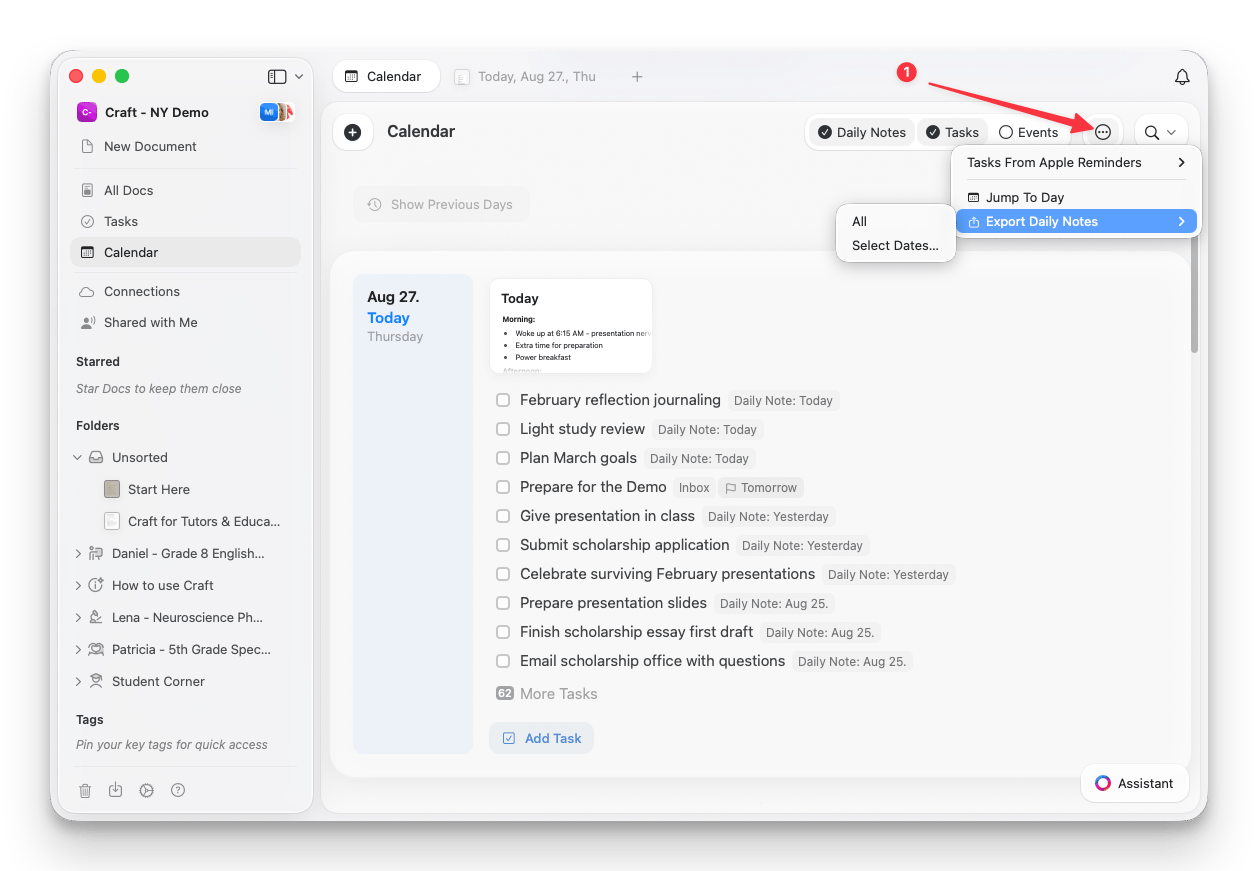
- From the Calendar
1
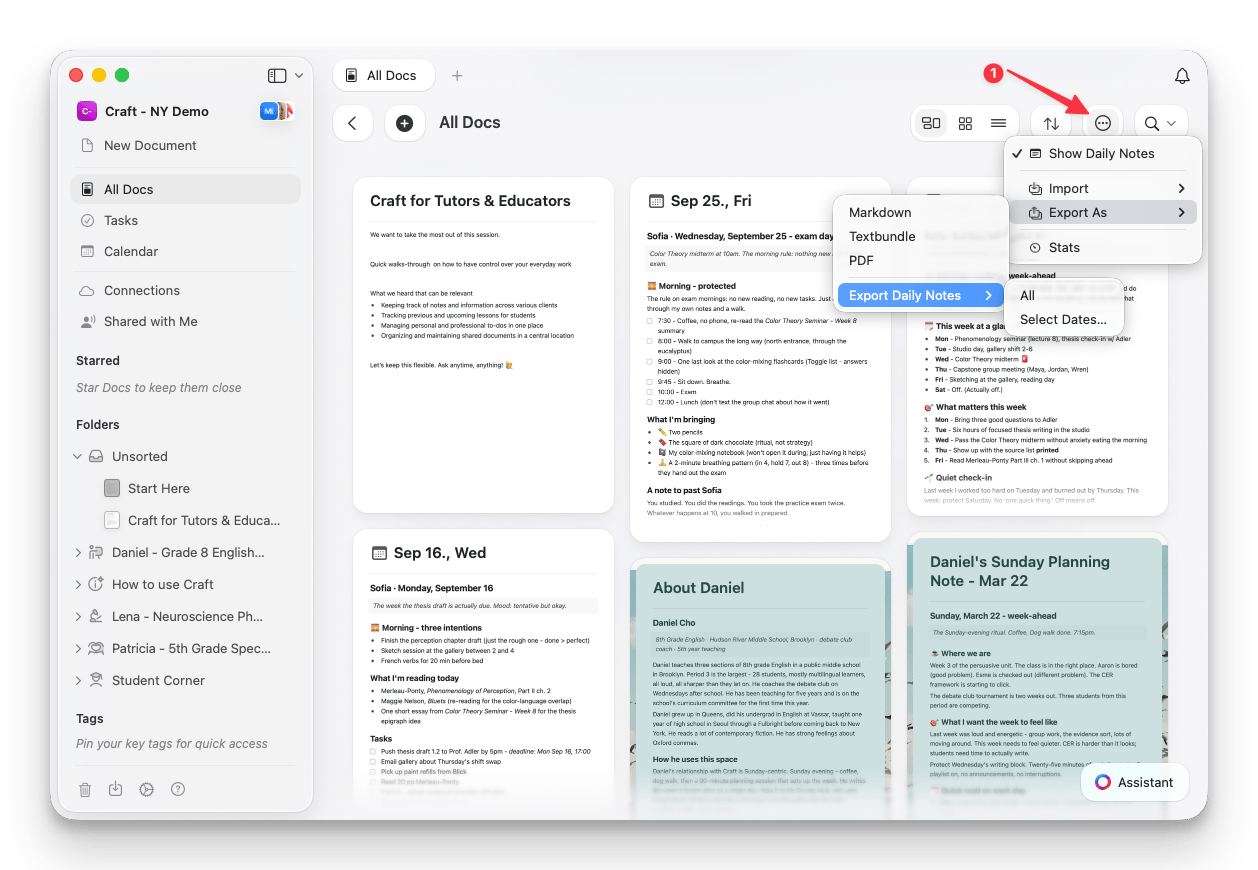
Open All Docs from the sidebar.
2
Tap the three-dot menu (⋯) in the top-right corner.
3
Select Export As, then Export Daily Notes.
4
Choose All, or Select Dates… to export a date range.
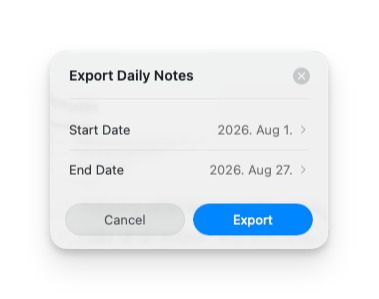
Days without a daily note are skipped.
Sharing vs. exporting
- To collaborate on a document, use Share Links instead of exporting. Others can then view or edit it in Craft.
- To publish a document on the web, use Public Links.